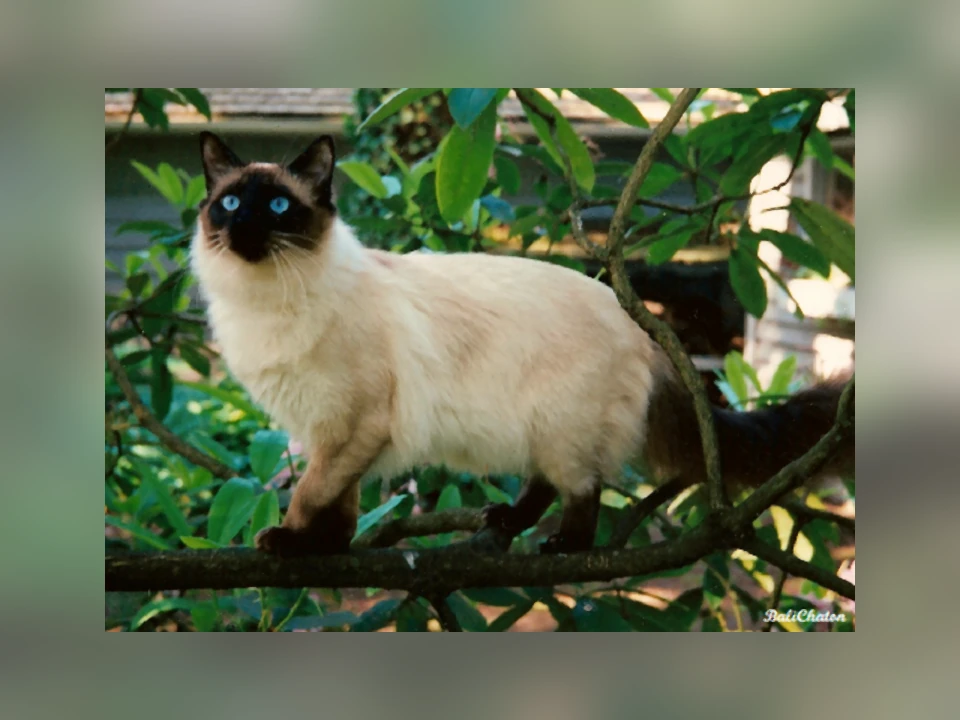
Meet the Balinese (the elegant, long-coated cousin of the Siamese)
The Balinese is, in almost every way that counts, a longhaired Siamese. The breed didn’t come from Bali at all — the name was chosen for the cats’ graceful, dancer-like movement, a nod to Balinese temple dancers. Its real origin is the United States, where breeders noticed longhaired kittens appearing naturally in Siamese litters and chose to develop them into a distinct breed in the mid-twentieth century. Both The International Cat Association (TICA) and the Cat Fanciers’ Association (CFA) recognize the Balinese as a sister breed to the Siamese.
Visually, the Balinese carries every Siamese hallmark: a long, lithe, athletic body, striking sapphire-blue almond-shaped eyes, and the same temperature-sensitive color points on the face, ears, paws, and tail. The headline difference is the coat — a semi-long, fine, silky single coat that lies close to the body, with a soft, plumed tail that’s the breed’s signature flourish. Because there’s no dense, woolly undercoat, the long hair reads as elegant rather than fluffy, and it tangles far less than you’d expect.
Personality & temperament
If you know the Siamese, you know the Balinese: this is one of the most social, intelligent, and affectionate cats you can share a home with. Balinese form intense attachments to their people and want to be involved in everything — working, cooking, reading, sleeping. They’re often described as “velcro cats” for good reason, and many will follow you from room to room rather than settle somewhere on their own.
They are also genuinely talkative. The Balinese inherited the Siamese love of conversation, greeting you, asking for food or attention, and commenting on the day in a voice that’s expressive and persistent (though many owners find it a touch softer than a full-throated Siamese). That chatter is part of the charm, but a sudden shift in how much or how your cat vocalizes can signal pain, stress, or illness — our guide on why your cat may be meowing so much helps you tell normal Balinese conversation from a warning sign.
All that intelligence needs an outlet. Balinese learn quickly, enjoy puzzle feeders and trick training, and can grow anxious or destructive when bored or lonely. Mental engagement isn’t optional with this breed — and crucially, they dislike being left alone.
The “hypoallergenic” question
The Balinese is one of the breeds most often marketed as “hypoallergenic,” and it’s worth being honest about what that does and doesn’t mean. Some Balinese are reported to produce lower levels of Fel d 1 — the protein in cat saliva and skin that triggers most cat allergies — which is why they appear on so many “lower-allergen breed” lists.
But no cat is truly hypoallergenic. Fel d 1 production varies from cat to cat (and even by sex and season), people’s sensitivities differ, and a single coat doesn’t eliminate the allergen — it’s the saliva and dander, not coat length, that matter most. Resources like the Cornell Feline Health Center are clear that “hypoallergenic” is an overstated label rather than a guarantee.
The practical takeaway: never buy a Balinese sight unseen on the strength of an allergy claim. If allergies are your reason for choosing the breed, arrange to spend real, repeated time around the specific cat or cattery first, and watch how you react. Trialing before you commit protects both you and a cat that might otherwise be returned.
Living with a Balinese
The single most important thing to understand before bringing one home is that a Balinese needs company. These cats bond deeply, thrive on interaction, and genuinely do not cope well when left alone for long stretches. A household where everyone is gone all day is honestly a poor fit, and a lonely Balinese can become stressed, bored, or destructive.
The happiest Balinese live with people who are home a lot — those who work from home, retirees, or busy households with steady comings and goings — and many do best with a feline or cat-friendly canine companion to lean on when their humans are out. Plan for plenty of enrichment, too: a tall cat tree, rotating toys, interactive wand play, and puzzle feeders all help burn energy and occupy that quick mind.
Grooming & care
Here the long coat is far less work than it looks. Because the Balinese has a fine, silky single coat with no thick undercoat, it mats little and sheds only modestly — a once-weekly brushing is usually enough to remove loose hair, prevent the occasional tangle, and keep the coat glossy. There’s no elaborate grooming routine, and the breed is broadly considered low-shedding for a longhaired cat.
The care priority that actually matters is the mouth. Like its Siamese ancestors, the Balinese is prone to dental and periodontal disease, one of the most common and most under-treated health problems in cats. Establishing a home toothbrushing routine plus professional cleanings as your veterinarian advises pays off over a lifetime — our cat dental care guide walks through how to start brushing and what warning signs to watch for.
Health
The Balinese is generally a long-lived, robust breed, but because it shares its genetic foundation with the Siamese, it carries the same handful of breed-linked considerations. Drawing on resources like the Cornell Feline Health Center and the Merck Veterinary Manual, areas to watch include:
- Dental and periodontal disease, common and very responsive to preventive care.
- Progressive retinal atrophy (PRA), an inherited, vision-reducing eye disease that responsible breeders screen against.
- Amyloidosis, a Siamese-line condition in which abnormal protein deposits can affect the liver and other organs.
- Respiratory and heart issues — the breed can be somewhat more prone to feline asthma and upper respiratory problems, with occasional heart conditions as in many cats; persistent coughing, wheezing, or labored breathing should be evaluated.
Because Balinese are routine-driven and often food-motivated, a cat that suddenly stops eating is a meaningful red flag. Cats are physiologically vulnerable to liver complications after even a short period without food, so don’t “wait and see” — our guide on what to do when your cat isn’t eating explains when it becomes an emergency. None of these conditions are universal, and individuals vary; the two best safeguards are choosing a reputable breeder who screens for inherited disease (or an honest rescue) and keeping up with routine veterinary care.
Is a Balinese right for you?
A Balinese is a brilliant, talkative, deeply affectionate companion — but only for the right home. If you’re around much of the day, want a cat that talks back, shadows your every move, and gives you a genuinely interactive relationship, few breeds give back more, and the elegant low-maintenance coat is a bonus rather than a burden. If you’re hoping for a quiet, independent cat that entertains itself while you’re out all day — or you’re counting on “hypoallergenic” as a guarantee — this is honestly the wrong match, and both you and the cat will be happier with a different choice.