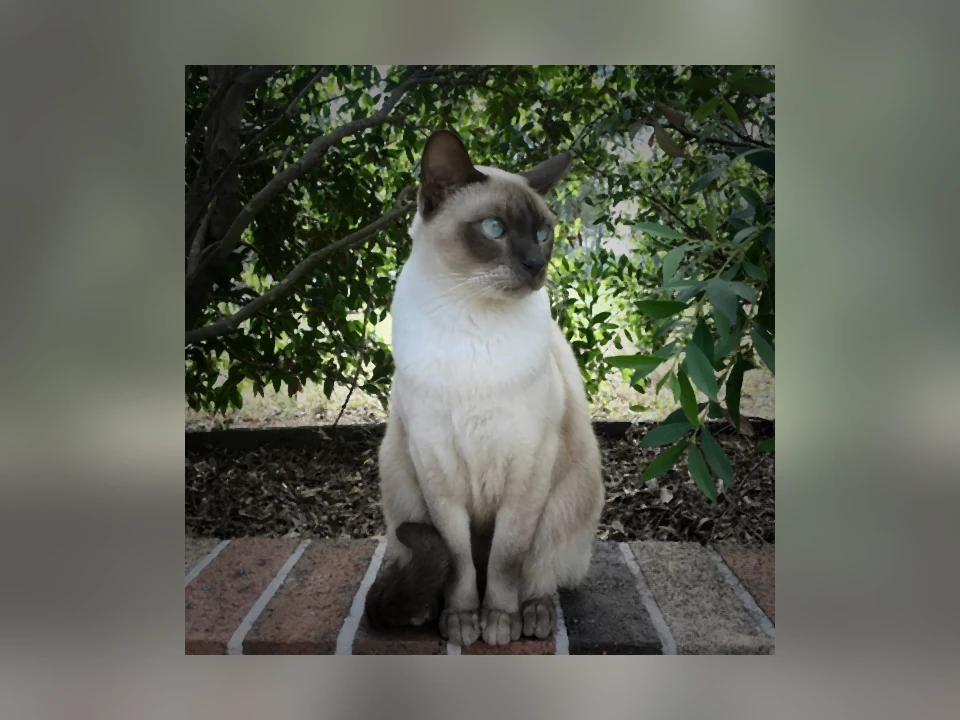
Meet the Tonkinese (the affectionate Siamese × Burmese blend — “Tonk”)
The Tonkinese is exactly what its parentage promises: a deliberate cross between the Siamese and the Burmese that captures the best of both. Affectionately nicknamed the “Tonk,” it’s a medium-sized, surprisingly muscular cat with a soft, close-lying coat in a “mink” pattern — a gentle gradient between body and points that’s a little less stark than a Siamese’s contrast. Its most arresting feature is often the eyes, which in classic mink Tonkinese glow a luminous aqua found in few other cats.
The modern breed was developed in Canada and the United States in the mid-twentieth century, with breeders intentionally combining Siamese and Burmese lines, and it is recognized today by The International Cat Association (TICA) and the Cat Fanciers’ Association (CFA). The result is a cat that looks elegant and refined but feels solid and athletic in your hands — and behaves like a devoted, talkative shadow.
Personality & temperament
Tonkinese are deeply social, playful, and affectionate, blending the Burmese’s people-obsessed devotion with the Siamese’s lively, mischievous energy. Many stay kitten-like well into adulthood, inventing games, fetching toys, and following you from room to room to stay involved in whatever you’re doing. This is not a cat that watches your life from across the room — it wants a front-row seat.
They are also notably talkative, though their voice tends to be chattier than the average cat while staying softer and sweeter than a full-throated Siamese. A Tonkinese will greet you, narrate its day, and politely (or insistently) ask for attention. That conversation is part of the charm, but a sudden change in how much or how your cat vocalizes can signal a problem — our guide on why your cat may be meowing so much helps you tell normal Tonk chatter from a warning sign.
The trade-off for all that affection is that Tonkinese genuinely dislike being alone. They bond intensely and can become bored, anxious, or lonely when left by themselves for long hours. This is a companion cat, not a self-sufficient one.
Living with a Tonkinese
Because the Tonkinese is so interactive, the most important question before bringing one home is who will keep it company. These cats thrive where someone is around much of the day — people who work from home, retirees, or busy households with steady comings and goings. If everyone is gone all day, a second sociable pet, ideally another cat or a cat-friendly dog, goes a long way toward meeting that need for companionship.
They are agile, athletic climbers who love wand play, puzzle feeders, and a tall cat tree to survey the household. Their intelligence and food motivation make them easy to engage, and many will happily learn to fetch or come when called. With their playful patience, Tonkinese tend to make excellent family cats, getting along well with respectful older children and other pets. If you’re bringing one home as a kitten, our new kitten checklist covers the supplies, vet visits, and first steps that set a Tonk up to thrive.
Grooming & care
Grooming is about as easy as cat care gets. The short, soft, mink-like coat lies close to the body, carries little undercoat, and sheds only modestly. A quick weekly brushing or a once-over with a grooming mitt removes loose hair and keeps the coat’s signature sheen — no mats, no elaborate routine.
The care priorities that actually matter are dental health and weight. Like its Siamese and Burmese ancestors, the Tonkinese is prone to gingivitis and periodontal disease, one of the most common and under-treated problems in cats; regular toothbrushing and professional cleanings make a real difference, and our cat dental care guide walks through a home routine. Because Tonks love both food and the people offering it, overfeeding is easy — keeping your cat lean protects its joints and overall health.
Health
The Tonkinese is generally a healthy, hardy breed, and hybrid vigor from its mixed Siamese-Burmese background may work in its favor. That said, drawing on resources like the Cornell Feline Health Center and the Merck Veterinary Manual, there are breed-linked considerations worth knowing.
Dental and periodontal disease is the most common day-to-day concern and the easiest to manage with preventive care. Because the breed descends from Siamese and Burmese lines, individual cats can inherit conditions seen in those parent breeds — including feline asthma and other respiratory issues (watch for coughing, wheezing, or labored breathing), amyloidosis or other inherited disorders in certain lines, and occasional heart conditions as in many cats. None of these are universal, and many Tonkinese live long, healthy lives, but they are reasons to take routine veterinary exams seriously.
As with any pedigreed cat, the single best safeguard is sourcing. Choose a reputable breeder who screens for inherited conditions and is transparent about their lines — or adopt from a rescue that’s honest about history — and then keep up with regular veterinary care. Remember that individuals vary; responsible breeding and adoption matter more than any single statistic.
Is a Tonkinese right for you?
A Tonkinese is an engaging, affectionate, chatty companion that gives back enormous warmth — for the right home. If you’re around much of the day, can offer plenty of interaction and enrichment (ideally alongside another pet), and want a cat that plays like a kitten for years, talks to you, and genuinely wants to be part of your life, few breeds are more rewarding. If you’re hoping for an independent, quiet cat that entertains itself while you’re out all day, the Tonkinese is honestly the wrong match, and both of you will be happier with a different breed.