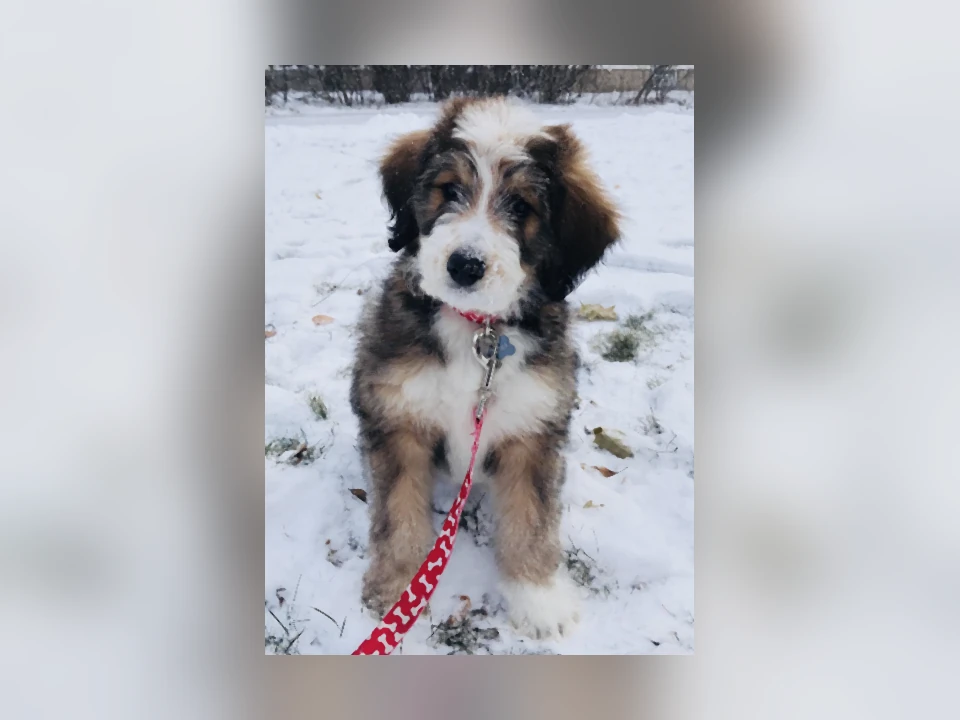
Origin
The Bernedoodle is a relatively new designer cross — the deliberate pairing of a Bernese Mountain Dog with a Poodle — first bred in earnest in the early 2000s. The goal was to combine the Bernese’s gentle, affectionate temperament with the Poodle’s intelligence and lower-shedding coat. Because it’s a crossbreed and not a recognized breed, there’s no single standard, and individuals vary widely in size, coat, and personality. That variability is the single most important thing to understand before getting one.
Personality and daily life
When the cross goes well, Bernedoodles are wonderful family dogs: affectionate, goofy, gentle, and deeply bonded to their people. They blend the Bernese’s mellow sweetness with the Poodle’s quick brain, and most are friendly with children and other pets. Some inherit a stubborn streak (often more Bernese than Poodle), and younger dogs can be exuberant, but the overall temperament is people-focused and good-natured. Like both parent breeds, they want to be with their family and don’t thrive left alone for long stretches.
Exercise and training
Exercise needs are moderate and scale with size — a Standard Bernedoodle needs more than a Mini. In general, plan on 45-60 minutes of daily activity: walks, play, and some mental enrichment. They’re intelligent and trainable, responding well to positive, reward-based methods; early socialization and consistent training head off the occasional stubbornness. Puzzle toys and training games suit their Poodle-side smarts.
Grooming
This is the big commitment. The wavy-to-curly coat mats easily and needs brushing several times a week, plus professional grooming roughly every 6-8 weeks. Curlier coats shed less but tangle more; wavier coats may shed a bit more. Keep the ears clean and ear hair managed to prevent infections. Anyone unwilling to budget time and money for grooming should think twice about this cross.
Health
A Bernedoodle inherits the health risks of both parent breeds — crossbreeding can add genetic diversity, but it doesn’t erase those risks, and the breeder’s testing is what matters most. From the Bernese side, watch for hip and elbow dysplasia (require OFA/PennHIP clearances on both parents) and, in larger Standards, bloat/GDV, a life-threatening stomach twist whose emergency signs every owner should know. From the Poodle side comes progressive retinal atrophy (PRA), which has a DNA test. Both parent breeds and the cross are prone to allergies and ear infections. Smaller varieties tend to live longer, with lifespans ranging from about 12 to 18 years.
Who this breed suits
A Bernedoodle suits a family or owner who wants an affectionate, trainable companion and can honestly commit to the grooming. It’s a poor fit for anyone counting on a guaranteed non-shedding or ‘hypoallergenic’ dog, or expecting a predictable size — those are the two places designer-dog marketing oversells. Choose a breeder who health-tests both parents and is transparent about the parents’ sizes, and you stand the best chance of a happy, healthy dog. Be skeptical of anyone selling rare colors at premium prices without showing you health clearances.