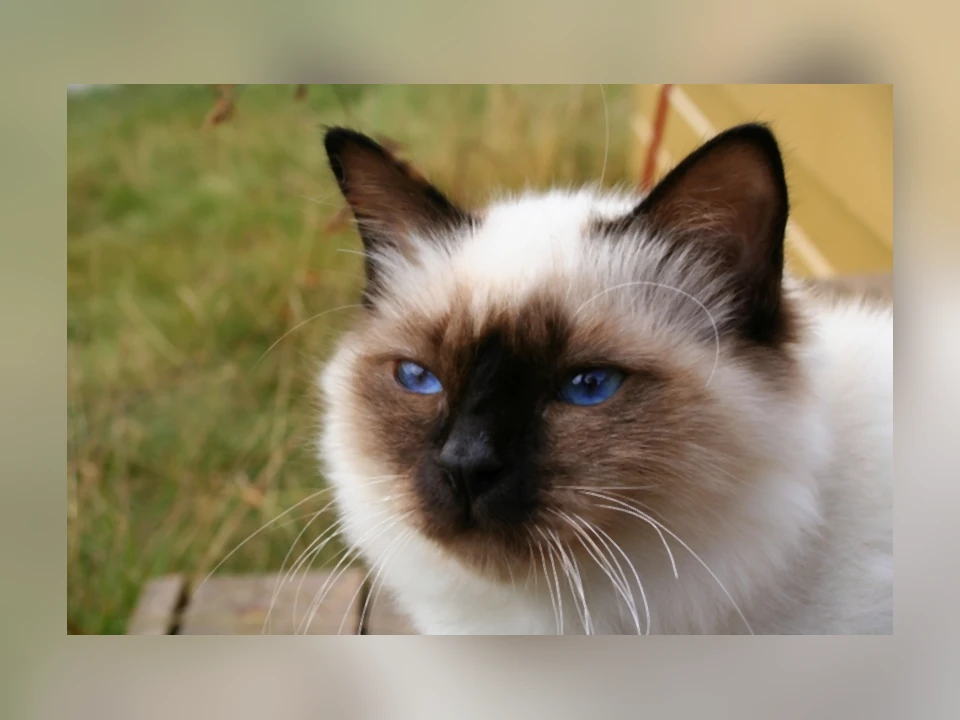
Meet the Birman (the “Sacred Cat of Burma” — color-pointed with white “gloved” paws)
The Birman is one of the most distinctive cats you’ll ever see: a color-point coat like a Siamese or Ragdoll, deep blue eyes, and four crisp white feet that look as though the cat dipped its paws in milk. Those white markings — “gloves” on the front paws and “laces” climbing up the back legs — are the breed’s signature, and a well-bred Birman wears them symmetrically. The breed’s nickname, the “Sacred Cat of Burma,” nods to a legend tying the cat to Burmese temples, though its documented history runs through France in the early twentieth century, where the modern Birman was established and recognized.
Birmans are medium to large cats with sturdy, well-muscled bodies, males running noticeably bigger than females. The Cat Fanciers’ Association and The International Cat Association recognize the breed in a range of point colors. But what owners remember isn’t the show standard — it’s the temperament. This is a famously gentle, sweet-natured cat bred to be a companion, with a silky coat that, refreshingly for a long-hair, doesn’t demand daily fuss.
Personality & temperament
The Birman’s calling card is its gentleness. These are quiet, affectionate, even-tempered cats that bond closely with their people and like to be wherever you are. Many Birmans will follow you from room to room, settle into your lap the moment you sit, and greet you at the door — sociable without being demanding. They tend to have soft voices and use them sparingly, so you get the companionship of a chatty breed without the constant commentary of, say, a Siamese.
That calm, people-loving nature makes Birmans wonderful with families. They’re typically patient with respectful children and get along with other cats and gentle dogs, fitting smoothly into a multi-pet household. They play, but at a measured pace rather than the relentless athleticism of a Bengal or Abyssinian. The flip side of all that devotion is that a Birman genuinely wants company — this is not a cat that thrives ignored, and one left alone for long stretches can grow lonely.
Living with a Birman
A Birman adapts well to almost any home, from a quiet apartment to a busy family house, asking for affection more than space. Their easygoing temperament and modest energy make them a comfortable indoor companion: content to nap in a sunny spot, supervise your work from the desk, and curl up against you in the evening. They’re quintessential lap cats — warm, trusting, and happiest in contact with their humans.
Because they’re so people-oriented, Birmans do best in homes where someone is around for at least part of the day, or where a second pet keeps them company. Give them interactive play, a few good perches, and your attention, and they’ll return it many times over. Like all cats, they’re safest living indoors or with access to a secure catio, where their trusting nature isn’t a liability around traffic or predators.
Grooming & care
Here’s where the Birman pleasantly surprises new owners. Unlike the Persian, which has a dense double coat that mats relentlessly, the Birman carries a single, silky coat with little undercoat — so it tangles far less and rarely needs the daily grooming long-hair breeds are notorious for. Brushing a couple of times a week, with an extra pass during seasonal sheds, is usually enough to keep the coat smooth and reduce the loose hair your cat swallows while self-grooming. Our guide to hairballs in cats explains how regular brushing cuts down on hairballs at the source.
The rest is the standard feline routine. Keep nails trimmed, check the ears, and don’t skip dental care — gum disease is one of the most common and overlooked problems in cats, so build a tooth-care habit early; our cat dental care guide walks through the basics. Birmans rarely need full baths, but the occasional one happens; see do cats need baths for when it’s worth it. Provide fresh water, a clean litter box, and an appropriate diet, and a Birman is genuinely low-fuss to keep looking good.
Health
Birmans are generally moderate-health cats with a good lifespan, but the breed’s relatively narrow gene pool means a few inherited concerns are worth taking seriously — and they’re a strong argument for buying from breeders who screen. The most significant is hypertrophic cardiomyopathy (HCM), the most common heart disease in cats; reputable breeders have their breeding cats echocardiogram-screened by a cardiologist, and your veterinarian should listen for murmurs at checkups. Polycystic kidney disease (PKD) appears in some color-point lines, so screened parents matter here too.
The breed has also been associated with occasional congenital issues, which is why responsible breeders test where they can and avoid doubling up on known carriers — ask to see health paperwork before you commit. Like all cats, Birmans can develop dental disease and, with their calm temperament and fondness for food, a tendency toward weight gain, which quietly worsens nearly every other health risk; our is my cat overweight guide can help you judge body condition. As Cornell Feline Health Center and the Merck Veterinary Manual note, knowing a breed’s hereditary risks lets your vet screen proactively rather than waiting for symptoms. The best protections are simple: a screening breeder or an honest rescue, regular checkups, and a watchful eye at home.
Is a Birman right for you?
If you want the elegant look of a long-haired cat without the grooming marathon — and a temperament to match — the Birman is hard to beat. It’s a gentle, affectionate, lower-maintenance companion that loves to be near its people, tolerates children and other pets, and brings a calm, steady presence to the household. For families wanting a true lap cat that’s easier to keep tidy than a Persian, this is one of the most rewarding breeds out there.
Go in clear-eyed, though. A Birman’s devotion means it doesn’t love being left alone for long stretches, so it suits a home with company more than an empty house all day. You’ll still owe it a couple of brushings a week, routine dental care, and portion control to keep weight in check. Most importantly, seek a breeder who echo-screens for HCM and tests for PKD, or adopt from a rescue that’s honest about a cat’s history. Do that, and you’ll likely share well over a decade with a sweet, gloved companion. Remember that every cat is an individual — temperament and health vary even within a litter — so meet the cat, not just the breed.