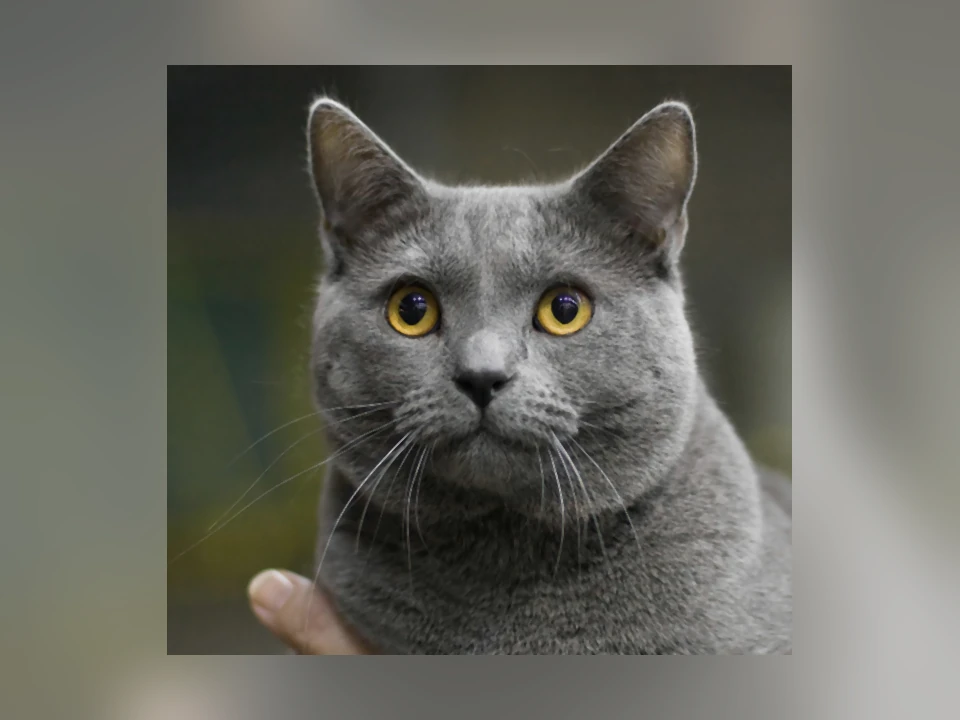
Meet the Chartreux (France’s quiet blue cat)
The Chartreux is one of the oldest natural breeds, a robust blue (gray) cat woven into French history and folklore for centuries — long associated with monastic life and admired by French writers. Today it’s something close to a national cat of France. Its look is distinctive: a sturdy, broad-chested body on relatively fine legs (a build sometimes likened to “a potato on toothpicks”), brilliant copper-to-orange eyes, and a face whose rounded contours and tapered muzzle give the breed its trademark gentle, smiling expression.
The coat is the other signature. It’s a short but dense, water-resistant double coat with a distinctly woolly, slightly resilient texture — closer to sheep’s wool than to a sleek shorthair — in shades of blue-gray from ash to slate.
Personality & temperament
If you want serenity, the Chartreux delivers. These are calm, even-tempered, quietly affectionate cats that bond closely with their families without being clingy or demanding. They tend to follow their people from room to room and settle nearby rather than insisting on constant lap time. Many are gently playful in short bursts, then return to their preferred state: composed observation.
The most striking trait is their near-silence. The Chartreux is renowned as one of the quietest cat breeds; a great many rarely vocalize, and those that do tend toward a soft chirp. They are intelligent and observant — some learn their names and simple games — but they express themselves through presence far more than voice. The overall impression is a dignified, easygoing companion that fits calmly into the rhythm of a home.
Living with a Chartreux
This is a low-key cat that adapts well to apartments, houses, families, seniors, and multi-pet homes alike. Its moderate-to-low energy means it won’t tear the place apart, but it still needs daily play to stay fit and engaged — and that’s not just for fun. The Chartreux’s placid nature and solid frame make weight gain easy, and excess weight stresses the joints. Keep portions measured and toys in rotation; our cat weight guide helps. They generally get along well with children, other cats, and calm dogs.
Grooming & care
Don’t be fooled by “shorthair” — the dense double coat needs real attention. Comb it about weekly (and more during seasonal sheds) using a wide-tooth comb; a slicker brush can actually mat the woolly undercoat rather than smooth it. Proper combing keeps the coat plush and tangle-free and controls the moderate shedding. Round out care with nail trims, ear checks, fresh water, and — as with nearly every cat — a regular tooth-brushing habit; see our cat dental care guide.
Health
The Chartreux is a generally hardy, robust breed, but a few conditions deserve watching:
- Patellar luxation — a slipping kneecap reported in the breed; mild cases are monitored, severe ones may need surgery.
- Struvite crystals and urolithiasis — the breed can be prone to bladder crystals and stones. Encourage water intake and treat any straining or litter-box changes as a prompt to see the vet.
- Hip dysplasia — uncommon in cats overall but documented in some larger, sturdy breeds; assess any persistent stiffness.
- Obesity — arguably the most practical day-to-day risk given the breed’s calm temperament; manage it proactively.
- Periodontal disease — common in cats and preventable with routine dental care.
Per the Cornell Feline Health Center and Merck Veterinary Manual, urinary and joint issues respond well to early attention. Choose a breeder who is transparent about their lines’ health, or adopt and keep up with routine vet checks.
Is a Chartreux right for you?
The Chartreux is an excellent match for anyone who wants a calm, quiet, gently affectionate cat that fits seamlessly into family life — including homes with children, seniors, or other pets — and who is willing to comb that woolly coat weekly and keep the cat trim. In return you get a robust, easygoing, almost serene companion with a centuries-old pedigree and an unmistakable smile.
It’s the wrong cat for someone craving a chatty, high-energy, attention-demanding personality, or for an owner unwilling to maintain a dense double coat.