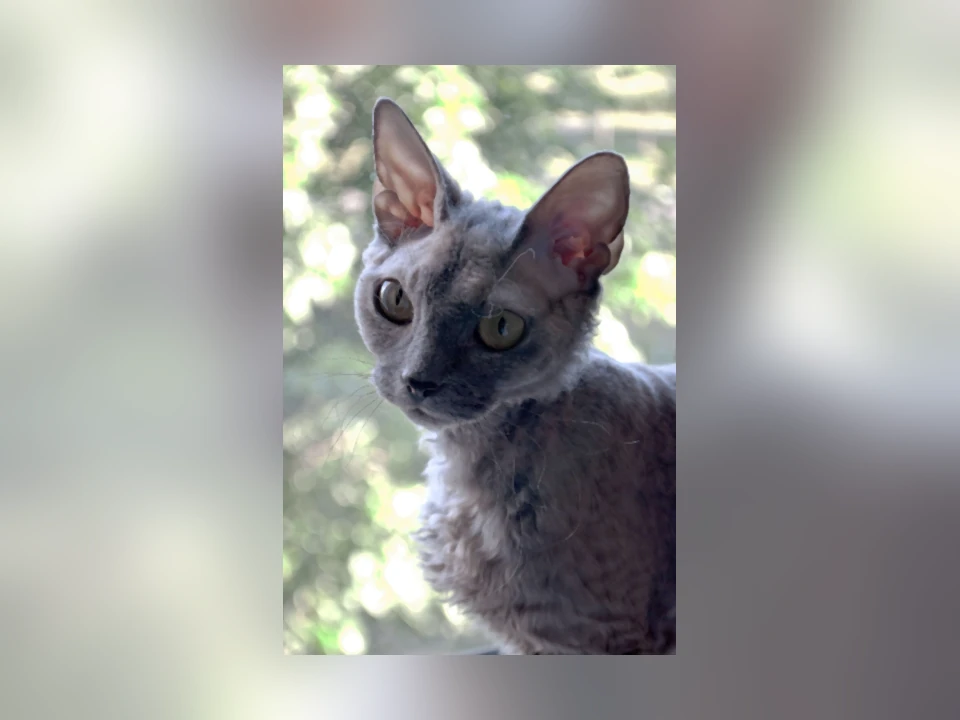
Meet the Devon Rex (big-eared “pixie cat” with a soft wavy coat)
Few cats look quite like the Devon Rex. With oversized, low-set ears, enormous eyes, sharp cheekbones, and a short muzzle, the breed has earned the nickname “pixie cat” — and once you’ve seen that impish face, it’s hard to forget. The coat completes the picture: short, exceptionally soft, and rippled into loose waves or curls that you want to touch the moment you spot it.
The breed traces back to Devon, England, where in 1960 a curly-coated kitten named Kirlee turned up in a feral litter. That single spontaneous mutation founded the entire breed. Importantly, the Devon’s curl comes from a different gene than the similar-looking Cornish Rex, which is why the two breeds are kept distinct. The International Cat Association (TICA) and other registries recognize the Devon Rex as a deliberately small founding gene pool — a fact that matters when we get to health.
Personality and temperament
If the Devon’s looks are striking, its personality is the real draw. This is one of the most people-oriented cats you can live with, frequently described as a “monkey in a cat suit.” Devons are mischievous, endlessly playful, and clever enough to invent their own games — and a fair amount of trouble. They climb, they perch, and they have a famous habit of riding around on their owner’s shoulders like a small, warm parrot.
Affection is not optional with this breed; it’s the whole point. Devon Rex want to be near you, on you, or watching you, and they greet attention with an enthusiasm that wins people over fast. They’re moderately talkative — more conversational than constantly loud — and they’re trainable enough to learn tricks, fetch, and respond to their name. That intelligence means a bored Devon will find its own entertainment, so keep them engaged.
One quirk is universal: they love warmth. Devons gravitate to laps, sunny spots, blankets, and the warmest body in the house, in part because their sparse coat offers less insulation than a typical cat’s.
Living with a Devon Rex
The single most important thing to know is that a Devon Rex hates being alone. They are active, interactive, and deeply attached, and a household where everyone is gone all day is a genuinely poor match. Many owners keep them in pairs or alongside another sociable pet so there’s always company.
Expect a cat that’s involved in everything. Devons follow you from room to room, supervise your work, and burrow into warm laps the moment you sit down. Give them vertical space to climb, puzzle feeders, and daily interactive play to satisfy that busy mind and athletic body. If your Devon is unusually vocal or its voice changes, that’s worth noticing — our guide on why your cat may be meowing so much helps you tell normal chattiness from a possible warning sign.
Grooming and care
The Devon’s coat is a paradox: it sheds very little, but it isn’t no-maintenance. Because the fine, sparse fur sits close to the skin and absorbs less natural oil than a dense coat, some Devons develop oily, slightly greasy skin — especially in the folds, around the nail beds, and at the base of the ears. Heavy brushing can actually damage the delicate hairs, so most owners skip brushes in favor of gentle, regular wiping with a soft, damp cloth, plus an occasional bath when the skin gets greasy. Our guide on whether cats need baths covers how to bathe a cat safely and how often is too often.
Those big ears need attention too. They produce wax readily and should be checked and gently cleaned on a regular schedule to prevent buildup and infection. And like many purebred cats, Devon Rex are prone to dental disease, so a routine of toothbrushing plus professional cleanings as your vet advises pays off — our cat dental care guide explains how to start.
Health
The Devon Rex is generally a charming, sturdy companion, but its small founding gene pool means responsible owners should understand the breed-linked risks. Drawing on resources like the Cornell Feline Health Center and the Merck Veterinary Manual, areas to watch include:
- Hypertrophic cardiomyopathy (HCM), the most common heart disease in cats, which can affect Devon lines; good breeders screen breeding cats and your vet may suggest periodic cardiac monitoring.
- Devon Rex myopathy, a hereditary muscle-weakness condition that can affect the strength of the head, neck, and limbs and appears in some lines; ethical breeders avoid affected cats.
- Patellar luxation, a kneecap that slips out of position and can cause intermittent limping or skipping.
- Hereditary baldness and skin issues, ranging from patchy or thin coat to oily skin and yeast overgrowth that needs gentle management.
- Dental and periodontal disease, common across purebred cats and very responsive to preventive care.
The strongest protection is choosing a breeder who screens for inherited conditions and is open about their lines, then keeping up with routine veterinary care. Avoid sources that can’t or won’t discuss health testing.
Is a Devon Rex right for you?
A Devon Rex is a hilarious, affectionate, endlessly entertaining companion — but it’s a full-contact relationship, not a low-key one. If you’re home a lot, want a cat that climbs onto your shoulder, supervises your day, and curls into every warm lap it can find, few breeds give back as much personality per pound. If you’re hoping for a quiet, independent cat that entertains itself while you’re away all day, this is honestly the wrong breed — and both you and the cat will be happier with a different match. Whether you buy from a health-screening breeder or adopt one in need, the Devon Rex rewards the time and company you can give it.