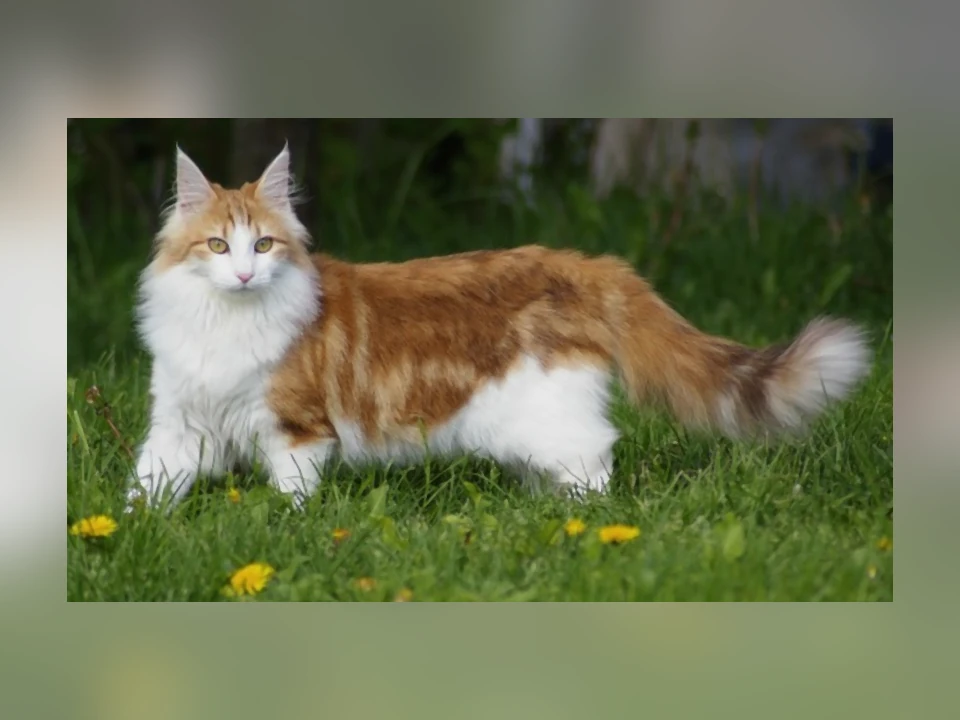
Meet the Norwegian Forest Cat (the sturdy, fluffy “Wegie” of Viking legend)
The Norwegian Forest Cat — affectionately called the “Wegie” — is a large, sturdy natural breed that developed over centuries in the cold forests of Norway. It’s a fixture of Norse folklore, where big, long-haired forest cats turn up in legend and fairy tale, and it’s easy to see why: with its thick, water-resistant double coat, tufted ears and toes, ruff around the neck, and long bushy tail, this is a cat built for surviving a Scandinavian winter. The Cat Fanciers’ Association (CFA) and TICA both recognize it as a beloved natural breed, shaped by climate rather than by a breeder’s wish list.
What strikes most people first is how substantial a Wegie is — a long, muscular body under all that fur — and how calm the personality inside it tends to be. These are handsome, hardy cats with an easygoing, friendly disposition. They’re often compared to the Maine Coon, another big-coated natural breed, but Wegie fanciers will tell you the two have their own distinct looks and characters. For the right home, a Norwegian Forest Cat is a striking, low-drama companion that’s content to share your space on its own gentle terms.
Personality and temperament
The Norwegian Forest Cat is best known for a calm, friendly, gentle nature paired with real intelligence and a streak of independence. These cats tend to be affectionate without being needy — they enjoy your company and will happily settle near you, but they’re also content to entertain themselves and aren’t the type to demand constant attention. That balance is a big part of the appeal: you get a sociable, good-natured cat that doesn’t cling.
Wegies are also natural climbers and problem-solvers. In their forest origins they were skilled at scaling trees and rocks, and that athleticism shows up at home as a love of high perches, cat trees, and the tops of bookshelves. They’re smart enough to enjoy puzzle feeders and interactive play, and they generally get along well with children, other cats, and dogs. They’re typically quiet, too — not a chatty breed — so you get personality without a lot of noise.
Living with a Wegie
Living with a Norwegian Forest Cat means planning for a big, athletic, climbing cat. They appreciate vertical space — sturdy cat trees and shelves that can take their weight — plus windows to watch and room to move. Because they’re agile and enjoy being up high, giving them legitimate places to climb keeps an intelligent cat happy and steers them away from improvising on your furniture.
Their size also shapes the practical setup. A large cat needs a large litter box sized for a long body, and a bigger frame means a bigger appetite, so portioning matters — feeding a complete diet to body condition rather than just filling the bowl keeps a big cat lean. Our guide on how much to feed a cat walks through getting the amounts right. The upside of the breed’s mellow, fairly independent temperament is that Wegies tend to be quiet, undemanding housemates once their needs for food, space, and a good climbing spot are met.
Grooming and care
That thick, water-resistant double coat is the breed’s signature — and its main maintenance task. A weekly brushing keeps the coat healthy most of the year, working through both the longer outer guard hairs and the dense undercoat to prevent the mats that form in friction zones: behind the ears, in the “armpits,” along the belly, and around the britches and tail. During heavy seasonal sheds — typically spring and fall, when the undercoat blows out — you’ll want to brush more often to stay ahead of loose hair and tangles.
Regular brushing pays off twice over. Beyond keeping the coat mat-free, it removes the loose hair a cat would otherwise swallow while self-grooming, which directly reduces hairballs; our guide on hairballs in cats explains how grooming and diet work together. Norwegian Forest Cats rarely need baths — their coat is famously water-resistant, which can actually make them harder to wet thoroughly — so most do fine with brushing alone; if you’re weighing whether yours needs one, our guide on whether cats need baths covers when it helps and when to skip it. Round out care with routine nail trims, gentle ear checks, and regular tooth brushing.
Health
Here’s where honesty matters most. The Norwegian Forest Cat is generally a robust, hardy breed, but it carries some documented inherited risks worth knowing before you commit. One is hypertrophic cardiomyopathy (HCM) — a thickening of the heart muscle that the Cornell Feline Health Center describes as the most common heart disease in cats. It has been reported in the breed, so responsible breeders should have their breeding cats echo-screened (a cardiac ultrasound) by a veterinary cardiologist.
The breed is also specifically associated with glycogen storage disease type IV (GSD IV), a serious inherited metabolic disorder. Crucially, there is a DNA test for it, which lets responsible breeders identify carriers and avoid producing affected kittens — making this one of the most important things to ask a breeder about. Beyond that, hip dysplasia (a malformation of the hip joint described in the Merck Veterinary Manual) is more likely in a large, heavy cat than in smaller breeds, and keeping your cat lean protects the joints; polycystic kidney disease (PKD) is another inherited condition documented in several breeds and worth screening for. None of this means an individual Wegie will develop these problems — most live full, healthy lives — but it’s exactly why health-screened parents matter so much.
The single best thing a prospective owner can do is choose a breeder who tests and screens — DNA testing for GSD IV, cardiac screening, and the relevant panels — and is transparent about results, or adopt from a reputable rescue that’s honest about a cat’s history. Pair that with keeping your cat lean, feeding a complete diet, and staying current on veterinary checkups, and you’ve given a Wegie the best possible start.
Is a Norwegian Forest Cat right for you?
For the right home, the Norwegian Forest Cat is a wonderful match: a hardy, handsome, easygoing companion with a calm, friendly nature, an independent streak that keeps it from being clingy, and the agility to turn your tallest perch into a favorite spot. That mix of striking looks and low-drama temperament is the whole reason the breed has so many devoted fans.
But it’s a commitment, and worth being honest with yourself about. Expect weekly grooming year-round — and more during heavy seasonal sheds — to keep that double coat mat-free, plus the shedding, food, and space that come with a big cat. And expect to screen breeders carefully, especially for HCM and the GSD IV DNA test. If you accept the grooming and shedding of a big double coat, few cats will reward you with as much quiet character and rugged good looks as a Wegie.