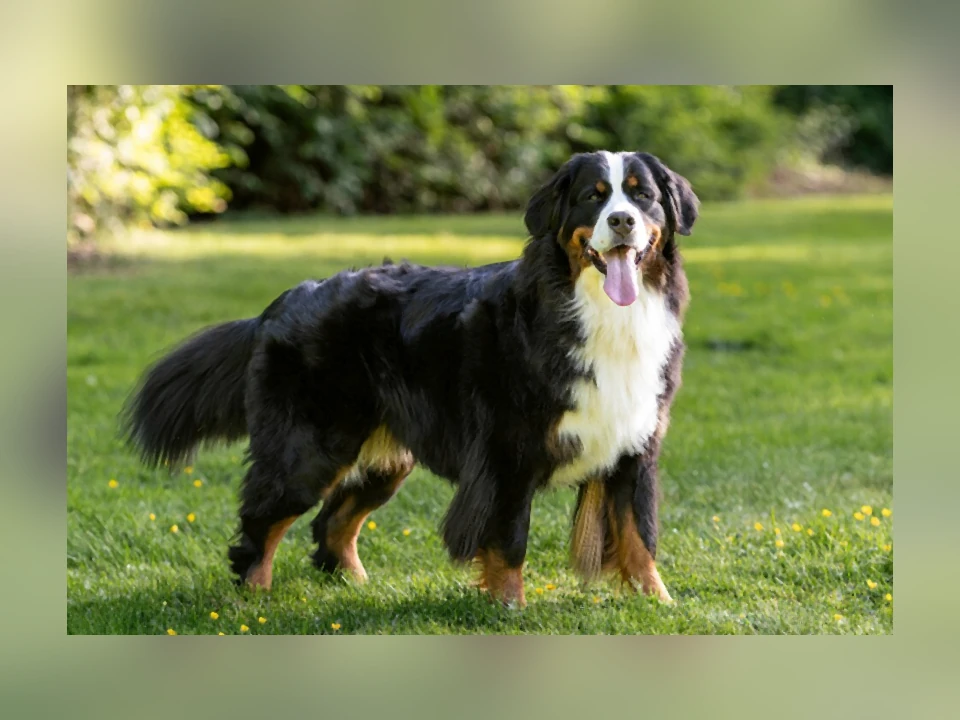
Meet the Bernese Mountain Dog (gentle tricolor Swiss farm giant)
Few dogs make a first impression quite like the Bernese Mountain Dog. Big, strikingly handsome, and unmistakable in its black, white, and rust tricolor coat, the “Berner” was developed in the farmlands around Bern, Switzerland, as an all-purpose working dog—pulling carts, driving cattle, and standing watch over the homestead. The AKC describes the breed as good-natured, calm, and strong, and that blend of muscle and mellow temperament is exactly the appeal.
What people fall for, though, isn’t the size or the show-ring looks. It’s the personality: a Berner is affectionate, steady, and devoted, the kind of dog that wants to be wherever its family is. Beneath the heavy double coat is a sensitive heart that thrives on closeness and gentle handling. This is a working giant with the soul of a homebody—happiest leaning against your leg, not patrolling a fence line.
Personality & temperament
Bernese Mountain Dogs are the archetypal gentle giants—typically calm, affectionate, and good-natured, forming deep bonds with their people and thriving on companionship. Many are wonderful with children and other animals when raised with them, and the breed leans warm and easygoing rather than sharp or pushy. A good Berner is more likely to greet a visitor with a slow tail wag than to challenge one, though its size and presence still command respect.
Two things define the breed’s character. First, Berners are notably sensitive: they don’t respond well to harsh corrections and do best with patient, consistent, positive-reinforcement training. Second, they are slow to mature, often staying puppy-brained well into their second or third year—charming, but it means manners take time and consistency to set. They are intelligent and generally eager to please, which makes them quite trainable, but their size means good manners aren’t optional. As always, individuals vary—genetics, upbringing, and socialization shape an adult dog’s personality far more than the breed label, whether you adopt through a breed rescue or start with a responsible breeder.
Living with a Berner
Despite their working heritage, Bernese Mountain Dogs have only moderate exercise needs—daily walks and room to move usually do the job, and they love a hike or a romp far more than a hard run. What they crave most is family time; a Berner left alone in the yard is a miserable Berner. Built for the Swiss Alps, they also love cool weather and can struggle in heat, so exercise during the cooler parts of the day in summer and always provide shade and water.
The practical realities are mostly about scale. This is a large, heavy dog, so plan for the space it needs and the cost it brings—food, beds, crates, and veterinary care all run big. If you’re raising a puppy, growth deserves real attention: giant breeds grow fast, and rapid growth stresses developing joints, so a controlled diet and sensible, low-impact exercise in the first year help protect them. Our guide on how big your puppy will get can help you plan for an adult this size.
Grooming & care
Grooming is a genuine commitment with a Berner. The long, thick double coat sheds heavily year-round and blows out dramatically during seasonal coat changes, so frequent brushing is non-negotiable—several times a week at minimum, and daily during heavy sheds—to prevent mats and manage the constant loose hair. Pay special attention to the dense undercoat and the feathering behind the ears, on the legs, and on the tail, where tangles love to hide. Our guide on managing dog shedding covers how to keep the fur under control.
Beyond the coat, stick to the basics: regular nail trims (long nails throw off a heavy dog’s gait), routine ear checks, and consistent dental care. Because a cooperative giant is far easier to handle than a reluctant one, build all of these grooming routines into puppyhood while your Berner is still small enough to manage.
Health
Health is where prospective owners need the most honesty, because the Bernese Mountain Dog carries some of the toughest realities in the dog world. Most significant is cancer: the breed has notably high cancer rates, and cancer is a leading cause of death among Berners. Paired with the short giant-breed lifespan—often only about 7 to 10 years—this means many owners face loss far sooner than they’d hoped. None of this is a reason not to love the breed, but it is essential to understand going in, and it makes choosing a breeder who selects for longevity and health-tests their lines genuinely important. Watch for new lumps, unexplained weight loss, or lethargy, and don’t delay a veterinary visit.
Other notable concerns include:
- Hip and elbow dysplasia. Common in large and giant breeds; ask for OFA hip and elbow clearances on both parents.
- Bloat, or gastric dilatation-volvulus (GDV). A life-threatening emergency in deep-chested dogs in which the stomach fills with gas and can twist. Learn the warning signs—a distended belly, restlessness, drooling, and unproductive retching—and treat them as an emergency; many owners discuss a prophylactic gastropexy with their veterinarian. Our dog bloat & GDV guide explains what to watch for and do.
- Degenerative myelopathy. A progressive, ultimately disabling spinal-cord disease seen in the breed; a DNA test is available to help responsible breeders make informed pairings.
Because Berners age quickly, senior care arrives sooner than with most breeds. The single best safeguard is to insist on health-tested lines: hip, elbow, and degenerative-myelopathy screening, plus a breeder who is candid about longevity in their dogs. Consult your veterinarian for screening tailored to your dog.
Is a Bernese Mountain Dog right for you?
A Bernese Mountain Dog can be one of the most affectionate, devoted companions you’ll ever share a home with—a calm, good-natured giant with a soft heart for its family and a gift for being exactly where you need it. For the right owner, that warmth is worth everything.
But “the right owner” is specific. You need space to house a dog this large comfortably, the budget to care for one at giant-breed scale, real tolerance for heavy shedding, and ideally a cool climate that suits the coat. Most of all, you have to go in clear-eyed about the hardest reality of all: a notably high cancer rate and a heartbreakingly short lifespan. If you can accept those trade-offs—and start with a responsible, health-testing breeder or a breed-specific rescue—a Bernese Mountain Dog will repay you with years, however few, of gentle, lean-into-your-side devotion.