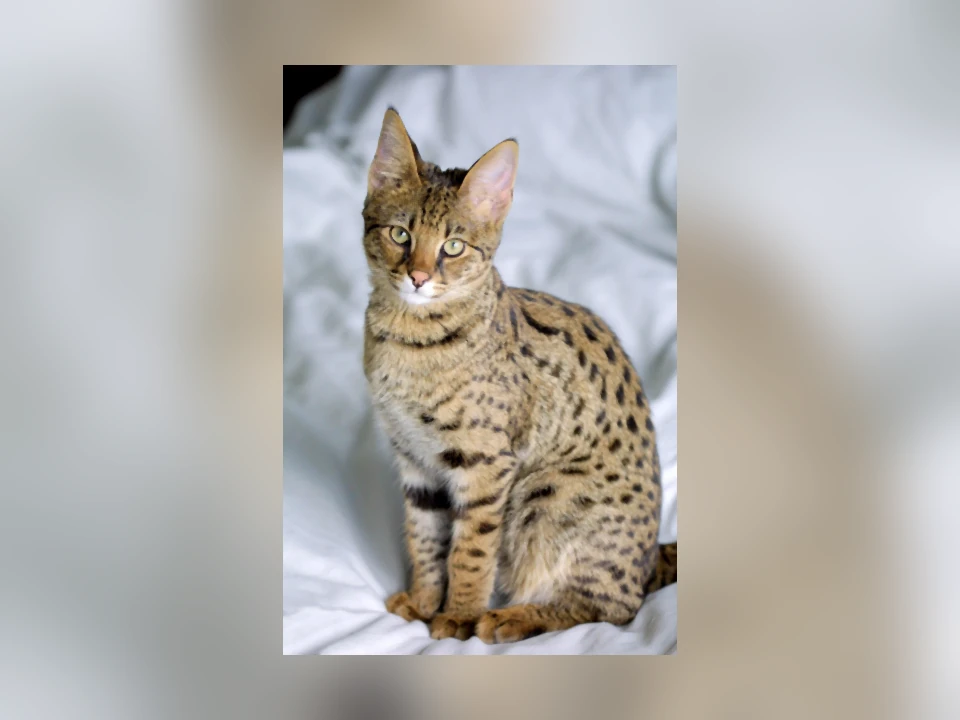
Meet the Savannah
The Savannah is one of the most striking cats you will ever see: tall, long-legged, and lean, with large upright ears, a small head, and a short coat patterned in bold dark spots. It was created in the United States by crossing a domestic cat with the African serval — a medium-sized wild cat — and then breeding those hybrids over successive generations. The International Cat Association (TICA) recognizes the Savannah and defines its breed standard.
That serval heritage is described by generation — F1 through F5 and beyond. An F1 has a serval parent and is the largest and most demanding; each higher number is one more generation removed from the wild ancestor, growing smaller and more pet-like. The same lineage that makes the breed spectacular also makes it a serious, sometimes legally restricted commitment.
The legal and ethical reality first
This is the part that matters most, so it comes first: early-generation Savannahs (often F1–F3) are banned or restricted in many U.S. states and cities, and in a number of other countries. Some jurisdictions classify them as exotic or wild animals; some require permits; some ban all Savannahs regardless of generation. Rules can differ between your state, your city, and even your landlord or HOA, so a cat that is legal one town over may be illegal where you live.
Before you so much as contact a breeder, confirm in writing exactly what is legal at your address — and ask which generation a kitten is. Beyond the law, this is an animal with demanding physical and behavioral needs a casual owner cannot realistically meet. A Savannah is not an impulse pet or a status symbol; choosing one responsibly means being honest about whether your home and local laws can truly accommodate it.
Personality and temperament
Savannahs are famous for acting more like dogs than cats. They are exceptionally active, athletic, and intelligent, with a curiosity that never quite switches off. Many can be leash-trained, taught to play fetch, and learn tricks quickly — they are problem-solvers who open doors and cabinets and invent their own games. They bond strongly with their people, following them from room to room well into adulthood.
They are also bold and physical. Savannahs leap to astonishing heights, and quite a few share the serval’s fascination with water, splashing in sinks or joining you at the tub. Individuals vary, but the common thread is intensity: this is a confident, interactive cat that wants a job to do and a partner to do it with. A sudden change in how much your cat talks can still signal stress or discomfort — our guide on why your cat may be meowing so much helps you read it.
Living with a Savannah
Here is the honest truth prospective owners most need: a Savannah needs enormous enrichment, and a bored Savannah is a destructive one. To live well, it needs tall, sturdy climbing structures, secure space it cannot escape from, rotating puzzle feeders and toys, daily interactive play and training, and often a companion to burn energy with. Without enough outlet, these powerful, clever cats climb, knock things over, shred, and find trouble an ordinary house cat never would.
Set the home up for this from day one rather than improvising later; our new kitten checklist covers the climbing and enrichment basics that matter most for a high-energy breed. Generation matters here too: later-generation cats (F4, F5, and beyond) are smaller and more pet-like, a more realistic fit for most homes, while early generations demand near-specialist commitment.
Grooming and care
Grooming, at least, is the easy part. The Savannah’s short, spotted coat is low-maintenance, sheds modestly, and needs little more than an occasional weekly brushing to remove loose hair and keep its shine — there is no elaborate routine and no heavy undercoat to mat. The real work of caring for a Savannah is never the coat; it is meeting the cat’s mental and physical needs every single day. Routine dental care and regular nail trims round out the rest.
Health
Savannahs are generally healthy and can be long-lived, but the breed carries considerations owners should understand. Drawing on resources like the Cornell Feline Health Center and the Merck Veterinary Manual, areas to watch include:
- Hypertrophic cardiomyopathy (HCM), the most common feline heart disease, which thickens the heart muscle and is reported in Savannahs; conscientious breeders periodically screen breeding cats by cardiac ultrasound.
- Anesthesia sensitivity, which some breeders and owners report; always tell your veterinary team the cat is a hybrid breed so they can plan a procedure accordingly.
- Diet and taurine needs, since early-generation cats may have higher protein and taurine requirements — feed a complete, balanced food and check with your vet before any raw or homemade diet.
- Pyruvate kinase (PK) deficiency, an inherited enzyme disorder that can cause anemia and is described in some hybrid lines; ask whether breeding cats are DNA-tested.
These are large, strong cats, so keeping them lean protects their joints; our guide on whether your cat is overweight explains how to assess body condition. The single most protective choice you can make is buying from a reputable TICA breeder who screens for HCM and is transparent about generation and health testing. Routine veterinary checkups do the rest.
Is a Savannah right for you?
A Savannah is a spectacular, brilliant, intensely interactive companion — for the right person, in the right place. If you are an experienced cat owner, home often, genuinely excited to train, climb-proof, and play with a powerful hybrid cat every day, and you have confirmed it is legal where you live, few animals are more rewarding. If any of those pieces is missing — the legality, the time, the experience, or the space — this is honestly the wrong breed, and both of you will be happier with a different match. Always verify local laws first, choose a responsible screening breeder over an unverified source, and go in clear-eyed about how much this cat will ask of you.