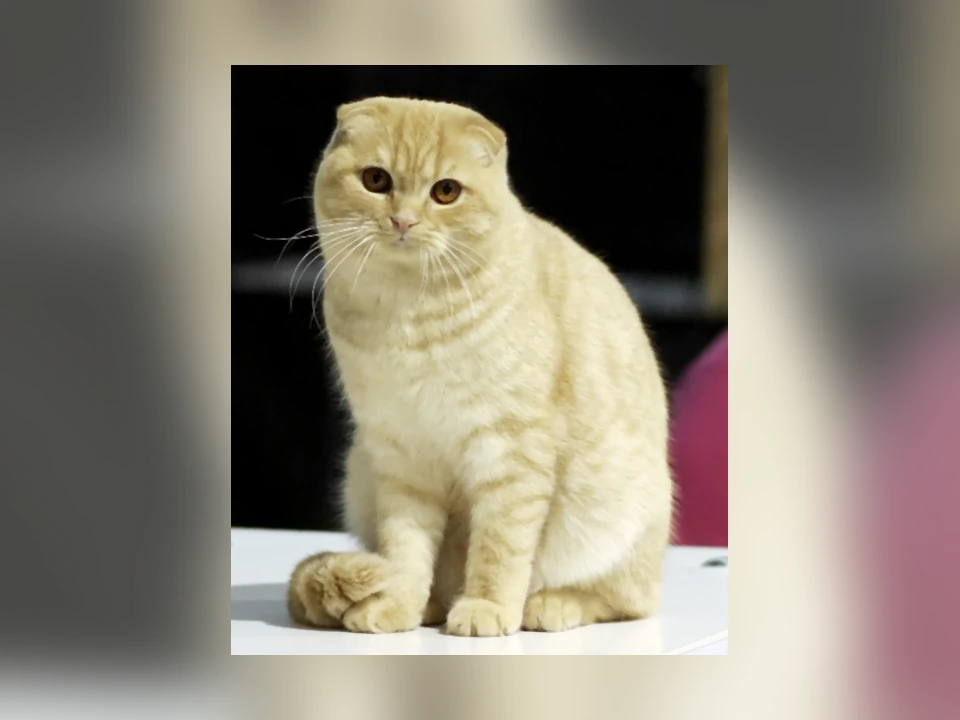
Meet the Scottish Fold (the round-faced cat with folded ears)
Few cats stop people in their tracks quite like a Scottish Fold. The signature folded ears, lying flat against a broad, round head, give the breed an unmistakable owl-like or “teddy bear” look, often paired with big, round, sweetly expressive eyes. The story is charming too: the breed traces to a single folded-ear farm cat named Susie, found in Scotland in 1961, whose descendants were developed into a recognized breed. TICA and other registries accept the Scottish Fold, and the cats have become enormously popular, boosted by celebrity owners and a constant stream of internet fame.
But this is a breed where affection and honesty have to travel together — and with the Scottish Fold, the honesty has to come first. The very mutation that folds those ears is not a harmless cosmetic quirk. It is a cartilage defect that affects the whole skeleton, and it carries a real, well-documented welfare cost. None of that makes individual folds any less lovable, and many live in homes and shelters already, fully deserving of great care. It does mean you owe it to the cat to understand what that folded ear really represents before you bring one home.
The welfare controversy you must understand first
There is no gentle way to say this, so here it is plainly: the same gene that folds a Scottish Fold’s ears also causes a painful, lifelong skeletal disease. The condition is called osteochondrodysplasia — abnormal development of cartilage and bone. The folded ear is simply the most visible sign that a cat’s cartilage doesn’t form normally; the same defective cartilage is present in the joints and tail throughout the body.
This is the crucial point that the cute photos never mention: it affects every Scottish Fold to some degree. Some cats show severe, obviously crippling changes early in life — fused, immobile, thickened tails, swollen joints, an abnormal gait, and reluctance to move. Others appear outwardly fine yet still carry abnormal cartilage that commonly leads to early-onset arthritis and chronic pain as they age. Because the disease is degenerative, it tends to worsen over time. There is no way to breed the folded ear without the cartilage defect — the two are inseparable.
For this reason, the breed is genuinely controversial among the people who know it best. Several cat registries do not accept the fold for breeding, and many veterinarians and welfare organizations — including International Cat Care — actively oppose or discourage breeding Scottish Folds. The ethical problem isn’t the cats; it’s that consumer demand drives more of them to be born with a condition that hurts.
If you already share your home with a fold, the most important thing you can do is stay alert. Watch for stiffness, a reluctance to jump, a stiff or thickened tail, an odd or stilted walk, or hesitation on stairs. These are not normal “lazy cat” quirks in this breed — they are signs of joint disease that deserve prompt attention. Our senior cat care guide covers how arthritis presents and how it’s managed, and it’s worth reading early, because folds often need that knowledge years before a typical cat would. Work closely with your veterinarian on a long-term pain-management plan; many folds live comfortable, happy lives when their pain is recognized and treated proactively.
Personality and temperament
Set the health realities aside for a moment and the Scottish Fold’s appeal becomes obvious. These are famously sweet, calm, and affectionate cats. They tend to be gentle and easygoing, bonding closely with their people and happy simply to be near you — often following you from room to room and settling in for quiet companionship.
Folds are generally adaptable and quiet. They’re not big talkers; when they do speak, it’s usually a soft, undemanding voice rather than the insistent yowl of a more vocal breed. Most are sociable and tolerant, getting along well with children, other cats, and calm dogs, which makes them a popular family cat. They like routine and gentle attention more than chaos. In temperament alone, it’s easy to see why people fall for them — which is exactly why the welfare facts have to be front and center.
Living with a Scottish Fold
Day-to-day life with a fold should be built around protecting those vulnerable joints. Favor gentle play over acrobatics: wand toys kept low to the ground, puzzle feeders, and ground-level games are kinder than encouraging big leaps onto high furniture. Provide soft bedding and make favorite perches reachable with low steps or ramps rather than long jumps, so your cat doesn’t have to load its joints to reach a windowsill or the sofa.
Above all, keep your fold lean. Excess weight piles extra strain onto joints that are already compromised, accelerating arthritis and pain — so weight control is one of the most concrete, everyday kindnesses you can offer. If you’re unsure where your cat falls, our guide on whether your cat is overweight walks through body-condition scoring and practical, vet-aligned ways to slim a cat down safely. Pay quiet attention to mobility over time, too: a fold that starts skipping the cat tree, struggling into the litter box, or grooming less may be telling you its joints hurt.
Grooming and care
Grooming a Scottish Fold is refreshingly straightforward and depends mostly on coat length. The shorthair variety needs little more than a weekly brush to remove loose hair and keep the dense coat healthy. The longhair version (sometimes called the Highland Fold) benefits from brushing two or three times a week to prevent tangles and mats. Both shed moderately, and routine brushing keeps it under control while cutting down on hairballs.
One small extra: those folded ears can trap a bit more wax and debris, so check them periodically and clean gently only if needed — never poke anything deep into the canal. Round out care with regular nail trims and, importantly, dental care. Like all cats, folds are prone to gum disease and painful tooth resorption, and our cat dental care guide explains how home brushing and veterinary cleanings protect their mouths — and spare them yet another source of discomfort.
Health
The center of this breed’s health profile is, unavoidably, its joints.
Osteochondrodysplasia and arthritis. As covered above, this fold-defining cartilage and bone disease is the breed’s defining health issue. It affects every fold to some degree and frequently produces early, progressive arthritis — most visibly in the tail, ankles, and knees. The Merck Veterinary Manual and feline pain-management guidance recognize osteoarthritis as a major, often under-treated source of feline suffering, and in this breed it tends to arrive sooner and hit harder.
Hypertrophic cardiomyopathy (HCM). The most common heart disease in cats, HCM thickens the heart muscle and can affect this breed. It’s often silent until advanced, so ask breeders about cardiac screening and have your vet listen for murmurs; watch for labored breathing, sudden weakness, or lethargy.
Polycystic kidney disease (PKD). This inherited disease, in which cysts gradually replace healthy kidney tissue, appears in some lines. Responsible breeders DNA-test for it, and increased thirst or urination is worth investigating with bloodwork.
The honest takeaway, echoed by the Cornell Feline Health Center and the AAFP, is that a Scottish Fold needs more proactive veterinary care than the average cat — particularly early, ongoing attention to joint comfort and pain.
Is a Scottish Fold right for you?
It’s worth being clear-eyed here, because this breed asks a harder question than most. The cats themselves are genuinely lovely — sweet, calm, affectionate companions that bond deeply and fit gently into family life. That warmth is real, and any fold already in a home or shelter deserves wholehearted love and excellent care.
The equally real truth is that every Scottish Fold lives with a degree of joint disease, and many will need lifelong arthritis and pain management. If you take one on, go in committed to keeping it lean, watching closely for stiffness and reluctance to jump, and partnering with a vet on proactive comfort care — and prepared, both emotionally and financially, for that responsibility. And consider the most ethical path of all: rather than buying a kitten and fueling demand for a painful trait, adopt a Scottish Fold already in need of a home. You’ll give a deserving cat the attentive, pain-aware care it requires — without asking another to be born into the same struggle.