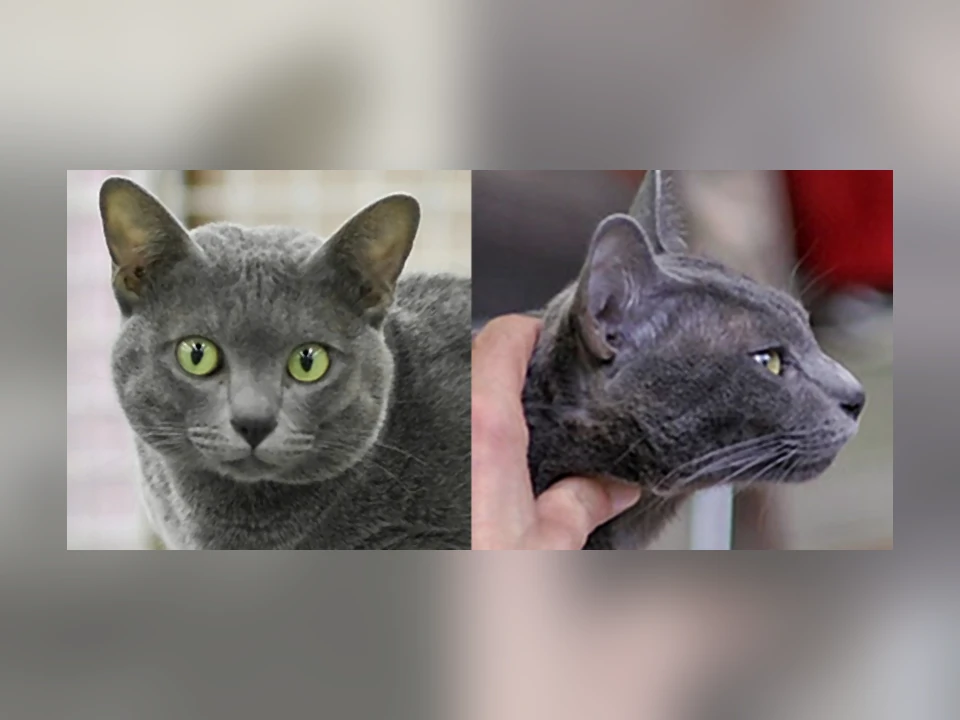
Meet the Korat (Thailand’s living good-luck charm)
The Korat is an ancient natural breed from Thailand, named for the Nakhon Ratchasima (Korat) region and treasured there for centuries as a symbol of good fortune — traditionally given in pairs to brides and to honored guests. It appears in the Tamra Maew, a centuries-old Thai book of cat poems, which makes it one of the few cats with a documented heritage going back hundreds of years.
Visually it’s unmistakable. The coat is a single, silver-tipped blue (gray) that seems to shimmer, the face is heart-shaped, and the eyes are a brilliant peridot green that doesn’t fully develop until the cat is around two years old. There’s only one coat color and one eye color in the standard — the Korat is exactly one beautiful thing.
Personality & temperament
Korats are devotion in a small package. They bond intensely, often to one or two favorite people, and they want to be genuinely involved — supervising, following, settling nearby, and communicating in a soft, expressive voice. Quietly assertive, they can be possessive of their humans and their routines, and many prefer to be the central cat in the household.
The defining trait, though, is sensitivity. Korats are intelligent and emotionally tuned-in, which makes them affectionate and responsive — but also means they don’t thrive on chaos. Loud, turbulent homes, frequent upheaval, or long hours alone can stress them, sometimes surfacing as over-grooming or litter-box changes. Match their calm, and you get one of the most loyal companions in the cat world.
Living with a Korat
Korats suit calmer homes — singles, couples, or quiet families with respectful older children. Their moderate energy makes them good apartment cats, and they’re not relentlessly loud, but they do need attention and dislike being ignored. Daily interactive play, a few good perches, and predictable routines keep them content. They can live happily with other cats when introductions are slow and they don’t feel displaced; some prefer to be the only pet.
Because they attach so strongly, plan for company. A Korat left alone for long stretches every day is a Korat at risk of stress-related problems.
Grooming & care
The single coat is low-maintenance: a weekly once-over with a soft brush or grooming glove keeps that silver sheen looking its best, and shedding is light. Add routine nail trims, ear checks, and fresh water.
Dental care is the maintenance task that matters most, as with nearly all cats. Build a tooth-brushing habit early with feline-safe toothpaste and keep up with professional cleanings — see our cat dental care guide.
Health
The Korat carries one genuinely serious, breed-specific health concern that overshadows the rest:
- GM1 and GM2 gangliosidosis — inherited lysosomal storage diseases that are progressive and fatal in affected kittens. This is the breed’s defining health issue. A DNA test reliably identifies carriers, so the disease is entirely preventable. Never buy a Korat without confirming that both parents have been tested clear or non-carrier. This single step protects you from heartbreak.
- Periodontal disease — common across cats; preventable with routine dental care.
- Stress-related problems — not a defined disease, but the breed’s sensitivity means a chaotic or lonely environment can cause over-grooming, appetite changes, or litter-box issues. Environment is part of health for a Korat.
Per the Merck Veterinary Manual, GM1/GM2 gangliosidosis is well characterized and DNA-testable in this breed — which is precisely why responsible sourcing is non-negotiable. Beyond that, Korats are generally hardy cats.
Is a Korat right for you?
The Korat is a wonderful match for someone who wants a deeply bonded, sensitive companion and can offer a calm, consistent home with real daily attention — and who will do the homework of buying only from a breeder who DNA-tests for GM1/GM2. In return you get a strikingly beautiful, intelligent, intensely loyal cat with a heritage stretching back centuries.
It’s the wrong cat for a noisy, unpredictable household, for someone away long hours with no companionship to offer, or for any buyer unwilling to verify the gangliosidosis testing that keeps this breed safe.